There are so many things I love about this video.
The tones of black and white occasionally flashing into color, the
grids, the boxes, the expressionless faces, the performers who seem to have come out of a painting by Khnopff, their elegant clothes, and of course, the smooth
beauty of the minimal music. I'm also fascinated by the atmosphere of metaphysical dread, the airless claustrophobia, the mausoleum-like room, the sense of ritual outside the bounds of earthly existence.
Tropic of Cancer is basically a solo project by Camella Lobo, assisted in live performances by Taylor Burch, of Dva Damas (another band worth mentioning at some point). Initially, TOC was a duo with Juan Mendez, but they quickly outgrew each other, and Camella continued alone. Accurately described by The Quietus as "excessively morbid and dark," Tropic of Cancer's music relentlessly and repetitively embraces a mood of bleak, hopeless despair. That's one part of the experience. The other part, which is important, is that the music is also glamorous, lush, romantic, and serenely decadent. It's not for everyone's taste, but gentle brokenhearted souls will feel like they belong there. Also for fans of minimal electronic, drone, shoegaze, postpunk, ambient, darkwave, and goth.
I came across this as I randomly stumbled through various blogs on Tumblr, eventually finding myself on some posts of exceedingly dark music. There was Larissa Iceglass, with her Louise Brooks hair, dressed in black, and a noose around her neck. I was immediately hooked. But what would it sound like? It sounded like some of the best post-punk, coldwavey stuff since the early 80's. It had everything that chilled my heart; the metronomic drum machine, the bass playing straight eighths, and the repeated, almost dissonant guitar riff. Larissa swings her arms and shuffles her legs back and forth like some mindless puppet, singing like a 21st century version of Nico. In other words, they nailed it. Lebanon Hanover has not revived post-punk, but they have taken its corpse, propped it up in a chair, and invited it to dinner. How they manage to do this and not come off as a ridiculous gimmick is beyond me. I'm sold. Lebanon Hanover is the real deal.
Since cancelling her endless touring last year I wondered what Charli might be up to next. Last year's collaborations with SOPHIE have resulted in some finished work finally being released, and it's pretty stunning. Plus, she has taken business into her own hands and started a label, Vroom Vroom. She's a Bosslady now, and I think that was a really good move on her part. In this new song, you can really sense the collaboration of the pair. The arrangement and treatment of how the song comes across is pure SOPHIE, while the sassy lyrics and harmonic content is very Charli indeed.
New single by September Girls from their upcoming album, Age of Indignation, due for release April 8th, 2016. It looks like it was filmed in a church, or a castle, it has black nail polish, and vaguely occult stuff, so that's all good with me:
I only got around to doing four posts this year, and one of them was my favorite music of 2014! Recently I have gotten hundreds of hits. I wonder what people are looking for? They must be so disappointed. As always, I preface my list by saying this is a very personal list, not necessarily the "best," or "most important" music of the last year. I don't even know what's good anymore. If I'm even a bit familiar with what's on other year-end lists I usually find it's something totally dreadful and dull. And we won't even talk about the Grammys. Still on my list from last year, Charli XCX. I continued listening to her a lot this year, even searching out her old albums and unreleased rarities hosted on obscure blogs. I continue to adore her because she's badass, angry at the right things, but also because she has so much positive energy, she's so "real," intelligent, funny, sensitive, and vulnerable. Also, she can't dance (try as she will), which makes her such an endearingly under-choreographed performer. I had so much respect for her last year when she quit a successful tour because she couldn't find the peace of mind for songwriting while on the road. That clearly demonstratedshe's first and foremost a composer.
Here's a little something from last year that she hasn't recorded yet. Charli only busts it out for her live shows and it's quite something as you shall see (it actually starts 39 sec in):
~ ~ ~ b #~ ~ ~
PINS. Couldn't have gotten through the year without these four tough chicks from Manchester. But they scare me a little bit.
~ ~ ~ b #~ ~ ~
I fully embraced Ringo Deathstarr this
year. It was hard at first to reconcile how they combine the dense
seriousness of the Shoegaze thing with their sort of stoner goofiness,
but in the end I was won over. Respect to all members of the band but,
in my opinion, Alex should be the only one doing vocals. Just saying...
~ ~ ~ b #~ ~ ~
Wolf Alice / No Joy. I still get these two bands confused because I listened to their albums back to back repeatedly. They are both female-fronted, guitar based bands that compose songs of Pop catchiness with a noise-rock approach. Both albums have great guitar tones, and they know how to arrange for the basic two guitar, bass, and drums ensemble.
~ ~ ~ b #~ ~ ~
Gwenno. I was a big fan of the retro girl group, The Pipettes, of which Gwenno Saunders was a member. Who'd have imagined that she would eventually release an album sung in Welsh, with songs about politics based on a sci-fi novel, titled Y
Dydd Olaf? Who'd have imagined that such an album would be so beautiful and rapturous? Or that it would be such an artistic success that it would be nominated for the Mercury Prize? Life is full of surprises. Sometimes they're even good.
~ ~ ~ b #~ ~ ~
Colleen Green. The shades, the drum machine. She's so "normal," yet so impossibly cool.
~ ~ ~ b #~ ~ ~
Lana Del Rey -Honeymoon. Remember when LDR first emergered? People weren't sure what to make of her. Was she for real? A parody? Delusional? Genius? Brain damaged? After Dan Auerbach produced Ultraviolence, he went on record about how brilliant she is to work with. Since then, she's considered a rare and ineffable "artiste," now taken seriously beyond reproach. I hate that about the music industry. After "the big rock guy" endorses the female musician, everybody breathes a sigh of relief, and decides she's legit after all. Honeymoon is a somber affair, full of faded, atmospheric regret and tragedy, more wistful than the darker Ultraviolence, yet still another masterpiece of vision.
~ ~ ~ b #~ ~ ~
NOTS. At a loss for words here. They're just, je ne sais pas, quelque chose de spécial.
~ ~ ~ b #~ ~ ~
Rose McDowell - Cut With The Cake Knife. Rose's demos for the what was supposed to be the second Strawberry Switchblade album saw the light of day almost 30 years later. The tracks do in fact sound like demos, although they're very nicely done, and they have an 80's datedness to them due to the available technology of the time. Make no mistake however, this is a delightful, charming, most wonderful album, I treasure every second of it. Rose, that sweet, beautiful, enigmatic creature, dressed like a dominatrix, singing like an angel, and making some of the most delicious pop music ever recorded. Truly, this a joy.
~ ~ ~ b #~ ~ ~
Favorite books of 2015: None. Don't have the time. Favorite movies of 2015: None. Don't like movies. ;)
I became a fan of Julie Campbell from the collaboration she did with Jah Wobble and Keith Levine, Psychic Life, in 2011. A magnificent work that, despite excellent reviews, just kind of disappeared without further mention. I sought out Campbell's LoneLady album, Nerve Up (2010), and was really impressed with her 21st century evocation of early 80's post punk. Julie keeps a very low profile, but eventually I saw that her new album, Hinterland, was released, and I jumped on that immediately. Hinterland is simply amazing. Campbell has a stunning feel for rhythm. Credit is given to Andrew Cheetham for "drums," but Julie is listed as playing about a half dozen vintage drum machines and pads, and what is evident from the outset is that her programming of those drum machines is what gives the album a lot of its personality. She plays guitar too, and the interplay of the machines and her snappy guitar playing is full of tight, twitchy, nervous energy. That energy is invigorating, fascinating, and full of surprises, coming at you from the right and left, at unexpected moments between the beats. Then, there's the LoneLady voice, gentle yet anguished, subtle but not without an edge, both reflective and urgent.
Julie has immense skill as a composer and a remarkable vision as an artist. I'm willing to follow her wherever her imagination takes her.
Jason Bourgeois (Northampton, MA) has been in a few bands, the pop group Bourgeois Heroes, the garage band The Novels, and Quiz Kids. He's established a connection with the reputable label, February Records, which has released some of his music with these bands. Now he's released a solo album on Bandcamp, called Jason Jr.It's a charming collection of Indiepop tunes, referencing the sound of the 70's, with influences from Nilsson, Laura Nyro, David Ruffin, and Todd Rundgren (now there's an imaginary supergroup for you!).
I would add Brian Wilson to the list of Jason's inspirations, because there is an element of Wilson's taste for unique instrumentation and harmonic surprises, popping up in songs like "Waiting Around," and "Someone From A Long Time Ago."
When I think about the 70's, I'm astounded at the number of sub-genres that suddenly emerged: prog, punk, disco, glam, southern rock, AOR, folk rock, and the cult of the sensitive singer-songwriter. The 70's were also cursed with dozens of really annoying pop singles, each one worse than the one before. Jason doesn't really fit in with any of those. There were just a few musicians already mentioned, like Todd Rundgren (in his "Runt" incarnation) and Harry Nilsson and, I suppose, a handful of others, who were not pretentious enough to be considered "arty," but who wrote with the tact and skill that made you cherish their music, even after New Wave, the New Romantics, and The Police came along to obliterate all that. This is the neighborhood where Jason Bourgeois lives. Jason's songs are sweet, and he has that vulnerable, "nice guy" voice that some might describe as "twee." That's not a bad thing on this blog, as we categorically abhor all screamers, shouters, and shriekers. This is the kind of thing one would have heard on the soundtracks of After School Specials; stuff that was done well enough to sound more or less contemporary in the early 70's, but also kind of unhip if you were into, say, maybe King Crimson or Genesis.
But this is not some imitative pastiche. I feel Jason's heart is in his songwriting. He knows what he's doing and he plays to his strengths.
For a long time now, the "bedroom producer" has been able to easily achieve
the seamless synchronization that is such a temptation for anyone using
a PC to record. One of the things I like about this album, is that
Jason is having none of that digital perfectionism. It is a solo album, but Jason enlisted
seven other musicians to contribute (besides the usual drums, bass,
keys, and guitar) xylophone, recorder, and electric sitar. He recorded everything live, with minimal overdubs, so the performances have an
appealingly loose, in-the-moment, feel.
Jason Jr. is for fans of The Cowsills, or The Partridge Family. OK, so there are no fans of those bands anymore, but that's kind of the hidden point here. Jason miraculously and accurately evokes a period of pop music that would have been reviled by the cool kids at the time. Now, as grown ups, those same kids would get teary-eyed by this music bringing them back to what eighth grade really felt like. One may have crafted an elaborate fantasy life listening to "Watcher of the Skies," but when you hear "My Best Friend," it's like getting punched in the gut with all the anxiety you endured in middle school. Jason seems to tap into those awkward moments, the things you wanted to say, the stuff you wanted to make happen, but were too messed up socially to finesse.
Spend time with this album and you'll encounter time machines that take quarters, lemonade stands, Mellotron flutes, harpsichords, choruses built on a girl's name, and the idea that love is more valuable than money. Sound naive? Maybe, but I'll take it over the mostly snarky, self-reflexive, sarcastic, and overcompressed bilge that fills the radio waves these days.
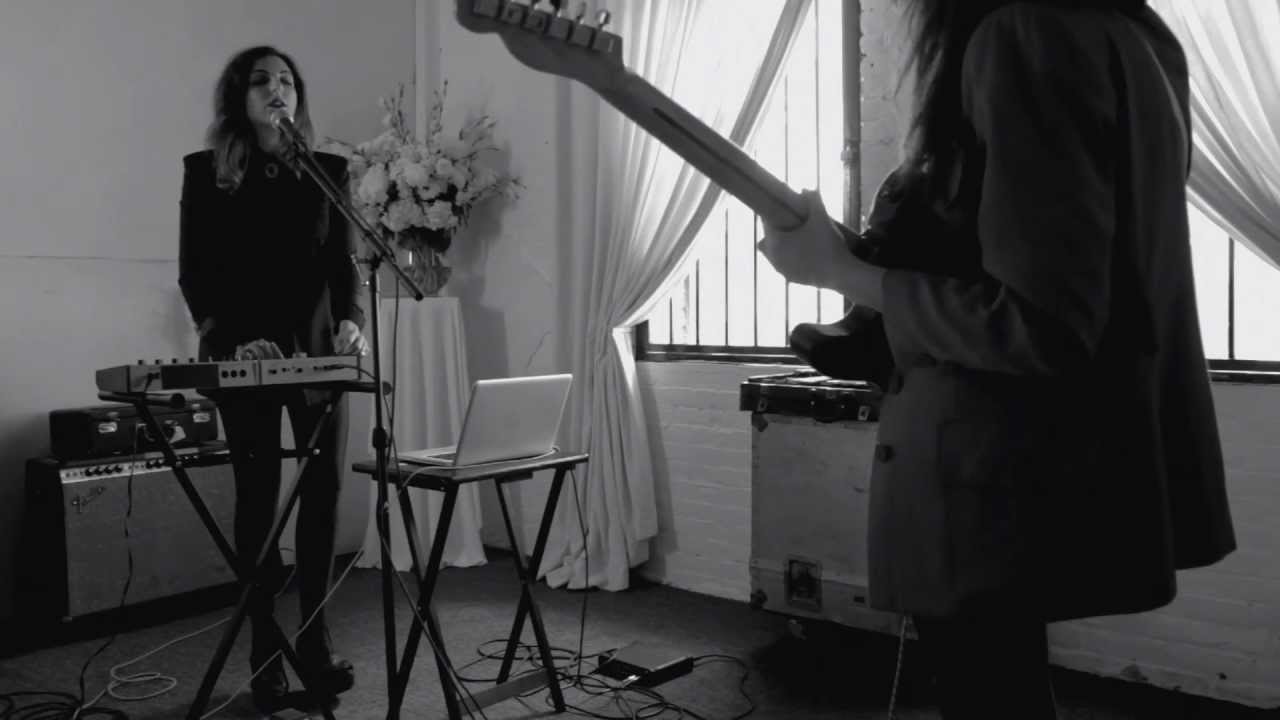 There are so many things I love about this video.
The tones of black and white occasionally flashing into color, the
grids, the boxes, the expressionless faces, the performers who seem to have come out of a painting by Khnopff, their elegant clothes, and of course, the smooth
beauty of the minimal music. I'm also fascinated by the atmosphere of metaphysical dread, the airless claustrophobia, the mausoleum-like room, the sense of ritual outside the bounds of earthly existence.
There are so many things I love about this video.
The tones of black and white occasionally flashing into color, the
grids, the boxes, the expressionless faces, the performers who seem to have come out of a painting by Khnopff, their elegant clothes, and of course, the smooth
beauty of the minimal music. I'm also fascinated by the atmosphere of metaphysical dread, the airless claustrophobia, the mausoleum-like room, the sense of ritual outside the bounds of earthly existence. 

